
| LVTP7: General | |||
| Date of first acceptance | 1971 | Total acceptances | 971 |
| Manufacturer | FMC Corp. | Crew |
|
| LVTP7: Dimensions | |||
| Combat weight | 50,350lbs 22,840kg |
Height | 128.5" 326.4cm |
| Length | 312.75" 794.39cm |
Width | 128.72" 326.95cm |
| Tread | 123.8" 314.5cm |
Ground clearance | 16" 41cm |
| Ground pressure, zero penetration | 7.7psi .54kg/cm² |
||
| LVTP7: Armament | ||||||
| Type | Mount | Ammunition | Traverse | Max traverse rate | Elevation | Max elevation rate |
| .50cal M85 MG | Armament station on hull right front | 400 rounds | 360° (manual and hydraulic) |
60°/sec | +60° to -15° (manual and hydraulic) |
60°/sec |
| Aiming equipment | ||||||
| Optical sight for gunner | ||||||
| Night vision | ||||||
| Infrared periscope M24 for driver | ||||||
| LVTP7: Armor | |||
| Assembly | |||
| Welding | |||
| Hull | |||
| 5083 aluminum alloy | |||
| Maximum | 1.75" 4.45cm |
Minimum | 1" 2.5cm |
| LVTP7: Automotive | |||||
| Engine | General Motors 8V53T; 8 cylinder, 2 cycle, vee, turbosupercharged diesel | ||||
| Horsepower | Gross: 400@2,800rpm | Torque | Gross: 825 ft-lb@2,150rpm | Fuel capacity | 180gal 680L |
| Transmission | FMC HS-400-3, 4 speeds forward, 2 reverse | ||||
| Steering | Hydrostatic, steering wheel | ||||
| Brakes | Mechanical | ||||
| LVTP7: Suspension | ||
| Type | Road wheels | Track return rollers |
| Torsion tube over bar | 6 individually sprung dual/track | Flat track |
| Drive sprockets | Idlers | Shock absorbers | 11-tooth front drive | Dual adjustable at rear of track | On first and last road wheels/track |
| LVTP7: Track | |||||||
| Center guide, single pin, steel with detachable rubber pad | |||||||
| Width | 21" 53cm |
Pitch | 6" 15cm |
Shoes/track | 84 | Ground contact length | 155" 394cm |
| LVTP7: Performance | |||
| Max level road speed | 40mph 64kph |
Max water speed | 8.4mph 14kph |
| Max trench | 96" 240cm |
Max sideslope | 60% |
| Max grade | 60% | Max vertical obstacle | 36" 91cm |
| Min turning diameter | Pivot | Max fording depth | Floats |
| Cruising range | ~300mi, roads ~56mi, water ~480km, roads ~90km, water |
||
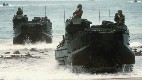
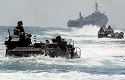
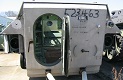
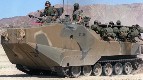
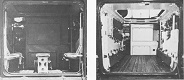
LVTP7 was a fully-enclosed vehicle with a very different shape than its amphibian predecessors. The vehicle was front-drive, and had a rear ramp for infantry entry and exit. The rear halves of the tracks were exposed, and the main propelling action in the water was by a water jet on either side of the vehicle. The driver and infantry troop commander each had a cupola on the left side of the hull, and the vehicle commander was positioned in the welded aluminum weapon station on the right side of the hull. The assistant driver was seated behind the troop commander. The cargo compartment had folding covers which allowed access from above. Maximum draft at combat-loaded weight was 67.8" (172cm), and freeboard at this weight to the driver's hatch coaming and the top deck radiator air intake grille was 33.0" (83.8cm) and 39.9" (101cm), respectively. The 24-volt electrical system was served by two sets of two 12-volt batteries connected in parallel. A 17lb (7.7kg) fixed Halon fire extinguisher was installed, and a portable 2.75lb (1.25kg) Halon extinguisher was also carried.
| AAVP7A1: General | |||
| Date of first acceptance | October 1983 | Total acceptances | 333 + 853 converted from LVTP7 |
| Manufacturer | FMC Corp. | Crew |
|
| AAVP7A1: Dimensions | |||
| Combat weight | 56,552lbs 25,652kg |
Height | 130.5" 331.5cm |
| Length | 321.3" 816.1cm |
Width | 128.7" 326.9cm |
| Tread | 123.8" 314.5cm |
Ground clearance | 16" 41cm |
| Ground pressure, zero penetration | 8.7psi .61kg/cm² |
||
| AAVP7A1: Armament | ||||||
| Type | Mount | Ammunition | Traverse | Max traverse rate | Elevation | |
| .50cal M2HB MG | Armament station on hull right front | 200 rounds ready | 360° (manual and electric) |
45°/sec | +60° to -15° (manual) |
|
| 40mm Automatic Grenade Launcher Mk. 19 | Armament station on hull right front | 100 rounds ready | 360° (manual and electric) |
45°/sec | +60° to -15° (manual) |
|
| Aiming equipment | ||||||
| Periscope M36E1 for gunner | ||||||
| Night vision | ||||||
| Passive AN/VVS-2(V)1A | ||||||
| AAVP7A1: Armor | |||
| Assembly | |||
| Welding | |||
| Hull | |||
| 5083 aluminum alloy | |||
| Maximum | 1.75" 4.45cm |
Minimum | 1" 2.5cm |
| AAVP7A1: Automotive | |||||
| Engine | Cummins VT400; 8 cylinder, 4 cycle, vee, turbosupercharged diesel | ||||
| Horsepower | Gross: 400@2,800rpm | Torque | Gross: 825 ft-lb@2,050rpm | Fuel capacity | 171gal 647L |
| Transmission | FMC HS-400-3A1, 4 speeds forward, 2 reverse | ||||
| Steering | Hydrostatic, steering wheel | ||||
| Brakes | Mechanical | ||||
| AAVP7A1: Suspension | ||
| Type | Road wheels | Track return rollers |
| Torsion tube over bar | 6 individually sprung dual/track | Flat track |
| Drive sprockets | Idlers | Shock absorbers | 11-tooth front drive | Dual adjustable at rear of track | On first and last road wheels/track |
| AAVP7A1: Track | |||||||
| Center guide, single pin, steel with detachable rubber pad | |||||||
| Width | 21" 53cm |
Pitch | 6" 15cm |
Shoes/track | 84 (85 on new vehicles) |
Ground contact length | 155" 394cm |
| AAVP7A1: Performance | |||
| Max level road speed | 45mph 72kph |
Max water speed | 8.2mph 13kph |
| Max trench | 96" 240cm |
Max sideslope | 60% |
| Max grade | 60% | Max vertical obstacle | 36" 91cm |
| Min turning diameter | Pivot | Max fording depth | Floats |
| Cruising range | ~300mi, roads ~56mi, water ~480km, roads ~90km, water |
||
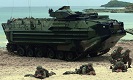
A service life extension program was instituted in the early 1980s to bring the LVTP7 up to speed in reliability, communications, and safety. The Cummins VT400 diesel engine replaced the GM 8V53T, and this was driven through FMC's HS-400-3A1 transmission. The suspension and shock absorbers were strengthened as well. The fuel tank was made safer, and a fuel-burning smoke generator system was added. Eight smoke grenade launchers were also placed around the armament station. The headlight clusters were housed in a square recess instead of the earlier round type. The driver was provided with an improved instrument panel, a night vision device, and a new ventilation system was installed. The water jet pumps had a capacity of 14,000gal/min (53,000L/min) with a static thrust of 3,025lb (13,460N). Two 7lb (3.2kg) Halon fire extinguishers were added to the 17lb (7.7kg) fixed extinguisher. These upgraded vehicles were originally called LVTP7A1, but the Marine Corps renamed the LVTP7A1 to AAVP7A1 in 1984. Another improvement was added in the form of a Cadillac Gage weapon station which was armed with both a .50cal machine gun and a 40mm automatic grenade launcher. Constructed of welded steel, the weapon station weighed 1,068kg (2,354lb) combat loaded, was 137cm (53.9") wide, 210cm (83") long without armament, and 190cm (75") tall overall. A 500,000-candlepower spotlight was attached above and elevated with the machine gun. The hydraulic traverse and elevation of the weapon station was replaced by electric motors, which eliminated the danger from hydraulic fluid fires. The weapon station was upgraded by AV Technology Corporation beginning in 1988, with weight increased to 1,227kg (2,705lb). Turret ring diameter was 100cm (39"). Applique armor kits were developed for the AAVP7A1, and the added weight of the new armor necessitated the addition of a bow plane kit when operating afloat.
In November 1998, a program to further prolong the life of the AAVP7A1 began. Under this AAV Reliability, Availability, Maintainability/Rebuild to Standard (AAV RAM/RS) plan, the AAVP7A1 will inherit the engine, transmission, and suspension of the M2 Bradley infantry fighting vehicle.